Beyond the Funnel: Building a Non-Linear Customer Journey Map That Matches Reality
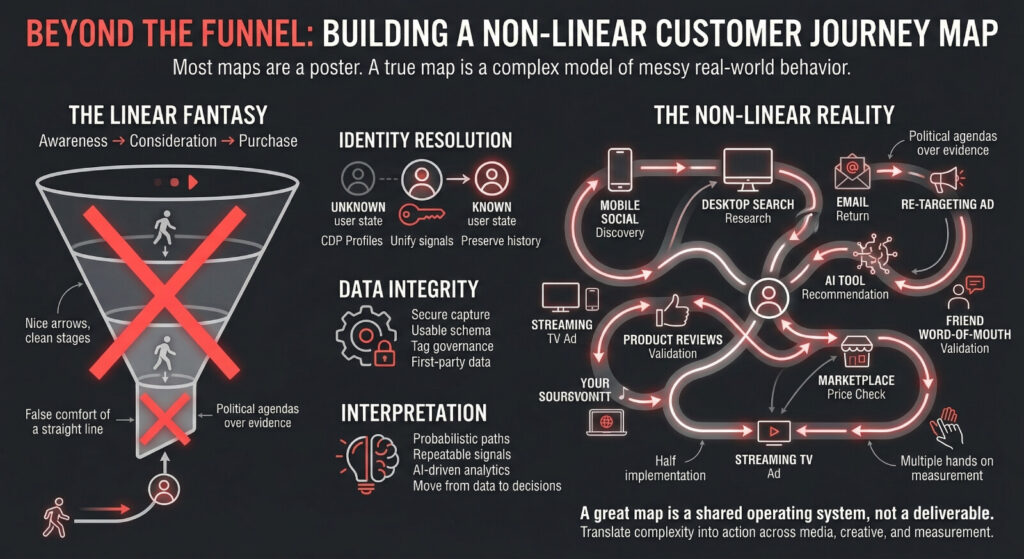
Most teams say they want a customer journey map. What they often mean is a clean, linear story: a person sees an ad, clicks, lands, converts. Neat stages. Nice arrows. A predictable funnel.
But modern buying behavior refuses to cooperate.
Today’s customers bounce between devices, channels, and sessions. They browse on mobile, compare on desktop, forget, return through search, see a retargeting ad, ask an AI tool for recommendations, then finally convert days later from a completely different touchpoint. Sometimes they never “click” at all, but still show up as a sale.
If your map can’t handle that mess, it’s not a map. It’s a poster.
This is where a non-linear customer journey map becomes a competitive advantage. Not because it’s fancier, but because it’s truer. And truth is what lets strategists make better bets.
The false comfort of the straight-line journey
The biggest assumption behind most journey mapping is that customers behave like they’re following instructions. They enter at Awareness, proceed to Consideration, then reach Purchase. The only “complexity” is how many times you need to show them the same message before they comply.
That assumption breaks for two reasons:
First, people don’t experience channels in isolation. They scroll social while watching streaming TV. They search while standing in a store aisle. They hear about a brand from a friend, then validate with reviews, then price-check on marketplaces.
Second, measurement doesn’t automatically equal understanding. A dashboard can show a lot of data while still telling an overly simple story.
A strategist-friendly journey map needs an at-a-glance view of the whole, plus digestible layers of detail that explain what’s actually happening under the hood. If it’s all detail, nobody uses it. If it’s all summary, nobody trusts it.
Why multi-device behavior breaks traditional mapping
Fragmentation is the enemy of linear storytelling.
One person might:
- Discover on mobile social
- Research on desktop search
- Return via email on mobile
- Convert through a branded query on desktop
Traditional approaches struggle because they treat those moments as separate people—or they over-credit the last visible touch.
It gets even messier in households. Multiple people can share a device. One login can be used by multiple family members. The “same” identifier can show wildly different intent patterns depending on time of day, context, or who’s actually holding the phone.
So the question isn’t “How do we draw the funnel better?” It’s “How do we model identity and intent when the journey is inherently disjointed?”
That’s the real work of customer journey analytics.
What you need to model a non-linear journey
A credible non-linear customer journey map requires capabilities in three areas: identity, data integrity, and interpretation.
1) Identity: turning unknown into known (without pretending it’s perfect)
At the heart of modern mapping is identity resolution—the ability to connect behavior from an “unknown” user state to a “known” user state once they authenticate, submit a form, or otherwise identify themselves.
This is where a customer data platform (CDP) can matter. Not as a shiny tool, but as a way to manage profiles, unify signals, and preserve the history of behavior that happened before someone became known.
In practical terms, you’re trying to answer:
- What happened before we knew who they were?
- Which behaviors tend to lead to becoming known?
- Which early signals correlate with eventual conversion?
Even with strong tooling, you still need to accept an imperfect world. There will always be a meaningful margin of error—shared devices, shared logins, cookie limitations, privacy constraints. The goal isn’t 100% certainty; the goal is directional clarity you can act on.
2) Data integrity: secure capture, storage, and modeling
A map is only as honest as its data foundation.
To handle messy journeys, you need a marketing technology stack that can securely capture events, store them in a usable schema, and support modeling across channels. This often includes:
- First-party data instrumentation (events, conversions, authenticated actions)
- Tag governance (e.g., Google Tag Manager)
- Consent-aware measurement aligned with data privacy expectations
- A clean event taxonomy so channels don’t speak different languages
If your inputs are inconsistent—multiple agencies tagging differently, departments optimizing to conflicting KPIs, or partial implementations of a strategy—the map will be wrong even if you have “lots of data.”
3) Interpretation: moving from data to decisions
The most common failure mode is oversimplification. Teams try to “clean up” the journey until it’s easy to explain… and accidentally remove the parts that would have explained performance.
Instead, treat the journey as a set of probabilistic paths:
- Patterns that tend to precede conversion
- Patterns that correlate with drop-off
- Segments that behave differently by time, device, or channel
This is where AI-driven marketing analytics can help—not as a buzzword, but as a practical way to sift through complexity and surface repeatable signals.
Why journey maps fail even when you have plenty of data
When a journey map doesn’t reflect reality, it’s rarely because a team “didn’t try hard enough.” It’s usually one of these issues:
- Too many conflicting goals. Different stakeholders want different outcomes (awareness vs. sales vs. lead quality), so the map becomes a compromise instead of a model.
- Politics over evidence. The data points one way, but internal agendas demand a different narrative.
- Half implementation. A strong strategy gets approved, then only a fraction is executed. The results underperform, and the model gets blamed.
- Siloed execution. Channels are optimized independently, so the journey can’t be understood holistically.
- Multiple hands on measurement. Inconsistent tagging and data definitions across teams create “measurement drift,” where nobody trusts the numbers.
A great map isn’t just a deliverable. It’s a shared operating system.
The first questions leadership should ask
If leadership wants a journey map that reflects real-world complexity, the first move isn’t asking for a prettier diagram.
It’s alignment.
Start with: What are we actually trying to achieve—and do we all mean the same thing?
Then immediately test it: Ask the team to repeat the vision back in their own words. Misalignment shows up fast when different people interpret the same goal in different ways.
From there, leadership should ask two grounding questions:
- What is our current state—right now?
- Can our data and tools connect behavior across devices well enough to support the decisions we want to make?
That “current state” question is where most organizations skip a step. Teams blur today’s reality with tomorrow’s ambition, and the journey map becomes aspirational instead of operational.
How to tell if your tools can’t answer the question today
Here are practical red flags that your journey map is not capturing cross-device reality:
- You can’t explain why branded search spikes without pointing to “probably awareness.”
- Conversions are heavily credited to last-touch channels, and upper-funnel impact is treated as unmeasurable.
- Authenticated vs. unauthenticated behavior is analyzed separately, with no bridge between them.
- Household/shared-device behavior creates noisy segments you can’t interpret.
- Stakeholders debate the numbers more than they debate what to do next.
If those sound familiar, you don’t need more dashboards. You need a stronger measurement framework built for messy behavior.
What strategists can do next
A modern customer journey map should do three things:
- Give an at-a-glance understanding of the big picture
- Provide layered detail for the moments that matter
- Translate complexity into actions across media, creative, and measurement
The brands that win aren’t the ones with the most linear story. They’re the ones that can model reality, accept uncertainty, and still make confident decisions.
Because the funnel isn’t dead. It’s just not the shape of the journey anymore.
About Tandem Theory
At Tandem Theory, we approach a customer journey map the same way we approach any serious growth initiative: as a living model of how customers actually behave—not a simplified diagram that fits neatly into a funnel. That means starting with clear business outcomes, establishing an honest current-state baseline, and building the data and measurement foundation—first-party data, identity resolution, and cross-channel modeling—that can withstand real-world complexity across devices and sessions. If you’re ready to move beyond linear assumptions and build a non-linear customer journey map you can trust to guide media, creative, and optimization, we’d love to help.