The First-Party Data Playbook: Building a Privacy-First Strategy That Actually Works
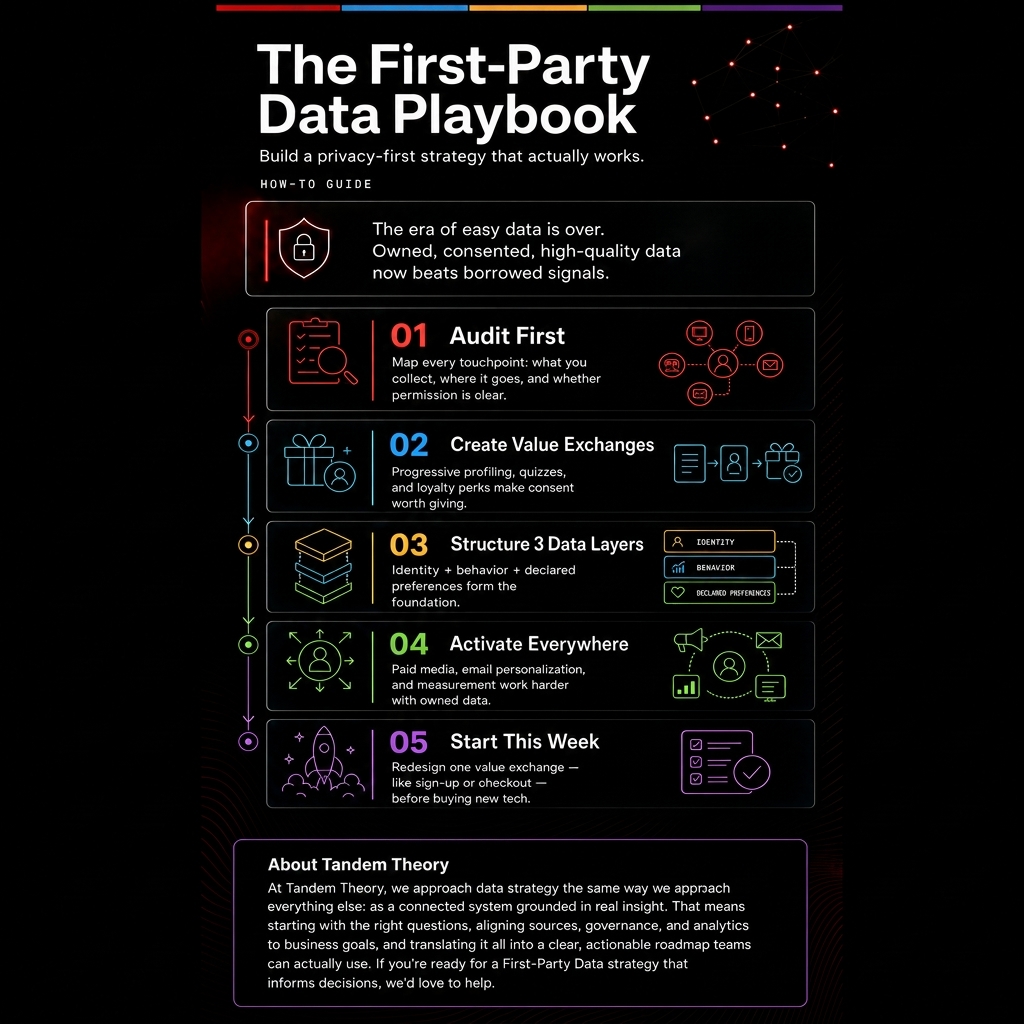
The era of easy data is over.
For years, we built targeting strategies on a foundation we didn’t own: third-party cookies, data brokers, and passive tracking that followed users around the internet without their knowledge. That foundation is gone. Google completed the deprecation of third-party cookies in 2024. Privacy regulations have raised compliance stakes considerably. And consumers have noticed. They’re paying attention to which brands earn their trust.
This is not a crisis. It’s a correction. The brands that treat it as a strategic opportunity will emerge with a durable competitive advantage.
Here’s the first-party data playbook we use with our clients.
Start With a Data Audit, Not a Technology Purchase
The instinct when facing a data challenge is often to buy something: a Customer Data Platform (CDP), a new Customer Relationship Marketing (CRM) platform, a consent management platform, and so on. Those tools may eventually be necessary, but buying technology before you understand your data landscape is like buying a filing cabinet before you know what you need to file.
Walk through every customer touchpoint and ask three questions: What data is being collected here? Where does it go? Do we have explicit permission to use it in the ways we’re using it?
You’ll likely find a patchwork. Email lists with unclear opt-in histories. CRM records with incomplete profile data. Loyalty program data siloed from your paid media activation. That patchwork is your starting point.
Build Value Exchanges That Actually Motivate Consent
Consumers haven’t become allergic to sharing data; they’ve become allergic to sharing data for nothing in return. “Sign up for our newsletter” is not a compelling value exchange anymore.
Progressive profiling collects a small amount of information at each interaction, adding depth over time. A new subscriber gives you an email. After their first purchase, you capture preferences. Each step feels proportional to the relationship.
Interactive content (quizzes, assessments, configurators) motivates voluntary data sharing by providing service, not just collecting information. A skincare brand that returns a personalized routine from five questions isn’t collecting data; it’s being genuinely helpful.
Reimagined loyalty programs create data-sharing moments that feel like privileges (early access, member-only content) rather than transactions.
Structure Your Data for Activation, Not Just Storage
Think about your first-party data in three layers:
- Identity layer: your known customer graph (email addresses, phone numbers, loyalty identifiers)
- Behavioral layer: what people do (pages visited, products browsed, purchases made)
- Declared preference layer: what people explicitly tell you (communication preferences, product interests, content topics)
Most organizations have all three layers but are rarely unified. A well-configured CRM or CDP can connect them into actionable profiles.
Activate First-Party Data Across Your Campaign Ecosystem
Paid media: Customer match capabilities across Google, Meta, LinkedIn, and Amazon let you upload first-party audience lists and build lookalike audiences that consistently outperform third-party demographic targeting.
Email personalization: A browse-abandonment email referencing specific products, calibrated to purchase history, is a fundamentally different thing from “we noticed you were looking around.”
Measurement: A strong first-party data foundation enables conversion paths that don’t depend on third-party cookies. You can run media mix modeling against real outcome data and close the loop between exposure and purchase in ways that were impossible with borrowed data.
The Practical Takeaway
Start with your audit this week. Map every touchpoint where data is collected and ask whether you have genuine permission to use it. Then identify one value exchange to redesign, likely your email sign-up or checkout guest flow.
The brands building privacy-first data strategies today aren’t doing it because regulators require it. They’re doing it because owned, consented, high-quality data is genuinely better than the borrowed alternative. That’s the shift worth making.
Everyone is collecting first-party data. Far fewer know what to do with it. That’s the gap between technology and strategy, and it’s exactly where Tandem Theory works. Humans + technology, turning your data into decisions that actually move the business. Ready to close the gap? Let’s Talk →