Beyond Likes and Reach: A Marketer’s Guide to Measuring Influencer ROI
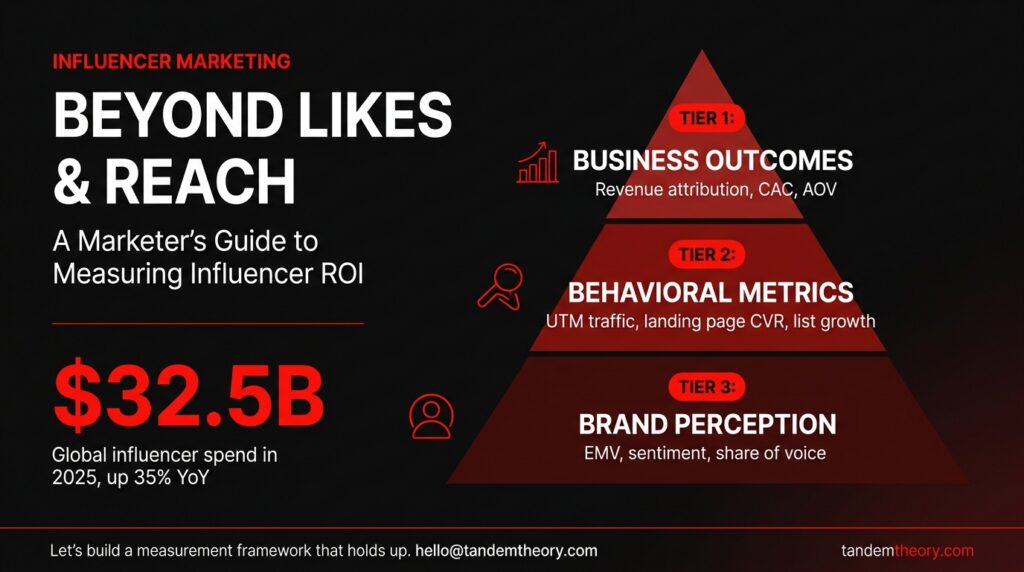
Global influencer marketing spend hit roughly $32.5 billion in 2025, up about 35% from the prior year (Statista). This is no longer a niche tactic; it is a budget line that CFOs are scrutinizing closely.
Yet, when CMOs are asked how they measure the return on that spend, the response is often the same: impressions, followers, and engagement rates. While these metrics may play a role in the selection process, they reveal little about whether the investment actually drove business results.
Here’s the good news: rigorous influencer measurement isn’t some unicorn framework only enterprise brands can afford. It just requires you to do a couple of unglamorous things before you brief: have the discipline to define success before the content goes live and build real attribution infrastructure around it.
Start With Business Objectives, Not Platform Metrics
Before a single creator gets briefed, answer one question honestly: what do we actually need this campaign to do?
Influencer work typically serves one of four jobs:
- Awareness
- Consideration/education
- Conversion
- Retention/loyalty
Each one of these demands a completely different measurement model. If you’re running an awareness play and grading it on checkout conversion, you’ve set the campaign up to “fail” before it started. That’s not a measurement problem. That’s a brief problem.
Write the objective down before launch. Then make sure every KPI you’re tracking ladders directly up to it and cut the ones that don’t. It sounds almost too simple to matter, but this single step is what prevents the most common post-campaign argument in this industry: “did this even work?”
The Vanity Metric Problem
Likes, comments, follower counts, raw impressions tell you reach existed, not that it did anything. And engagement rate specifically has become one of the most gamed numbers in marketing; it’s trivially inflated by pods, giveaways, and comment-bait captions.
We find it more useful to organize influencer metrics into three tiers, in descending order of how much they should actually influence your next budget decision:
Tier 1: Business outcome metrics. Revenue attribution, customer acquisition cost by influencer channel, average order value from creator-driven traffic, and new-customer percentage from influencer cohorts.
Tier 2: Behavioral metrics. Website traffic from creator-specific UTMs, landing page conversion rate by creator, and email/SMS list growth tied to creator promotions.
Tier 3: Brand perception metrics. Earned media value, sentiment shift in social listening, share-of-voice movement, and branded search lift.
These tiers are hierarchical: Tier 3 is not a substitute for Tier 1.
Building Your Attribution Infrastructure
Every creator should receive a unique tagged link or landing page; while it is tempting to share links for simplicity, this is an essential setup.
Creator-specific promo codes draw a clean, auditable line from a post to a purchase. One caveat worth planning for up front: codes tend to attract deal seekers, so track the lifetime value of that cohort separately rather than assuming it behaves like your average customer.
Post-purchase surveys are underused, and they catch what pixels structurally can’t. A simple “how did you hear about us?” at checkout surfaces influence that never generates a click, yet represents the person who saw a creator’s story three weeks ago, forgot about it, then bought later through a search.
Brand lift studies, which are available natively on YouTube, Meta, and TikTok are worth the investment on larger campaigns. They’re the only tool on this list that gives you a statistically valid read on awareness, recall, and purchase intent, rather than a proxy for it.
Calculating Earned Media Value…Correctly
EMV is frequently misused, often appearing as the headline number in recap decks rather than as supporting data. Use it as a directional benchmark, not the primary measure of success.
The fix is simple: calculate EMV using your own historical CPM, not an industry average pulled from a blog post (like, well, this one). Say your brand’s actual Instagram CPM runs $8, and a creator generates 400,000 impressions which is roughly $3,200 in EMV. That’s a useful data point for sanity-checking scale. It is not, on its own, evidence the campaign worked. Put it next to conversion data, not in place of it.
The Influencer Measurement Checklist
Before your next campaign launches:
- Set the objective(s) in writing. Awareness, consideration, conversion, or retention.
- Match KPIs to that objective. Cut anything that doesn’t connect.
- Build attribution infrastructure. UTMs, landing pages, promo codes, post-purchase surveys.
- Establish baselines. Align on brand sentiment, branded search volume, and conversion benchmarks before the campaign begins, not reverse-engineered after.
- Define success in advance. Agree on the number, or at least a defensible range, before results come in and someone gets tempted to move the goalposts on you.
The brands winning at influencer marketing right now aren’t necessarily spending more than everyone else. They’re measuring better, and they’re walking into the CFO review with numbers that hold up under a follow-up question.
Ready to build a measurement framework that goes beyond engagement rates? Let’s talk. hello@tandemtheory.com