Account Based Marketing Was Always Smart. AI Makes It Practical.
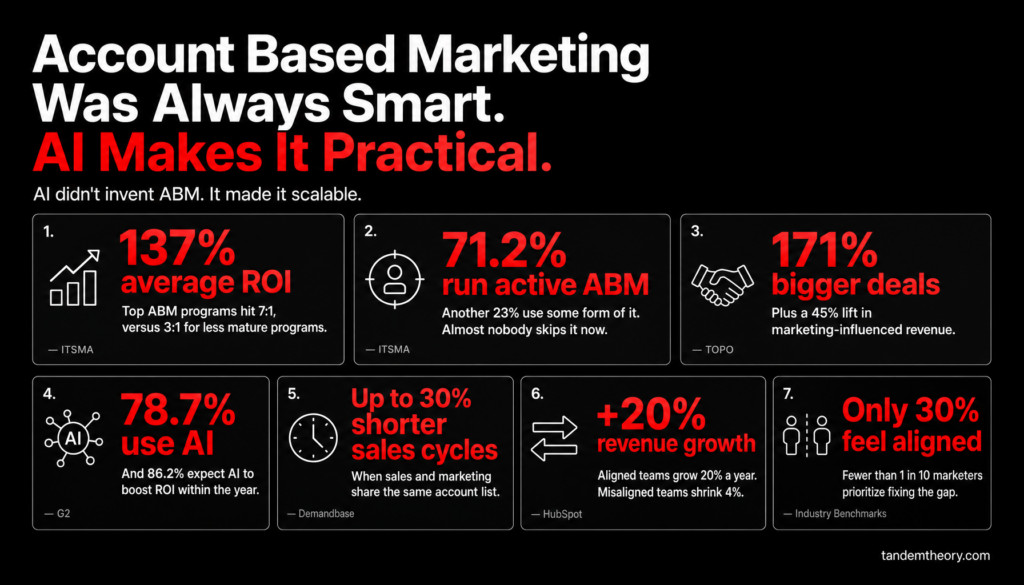
Account Based Marketing (ABM) works. The strategy has always been sound. Today, 71.2% of B2B organizations run an active ABM program, and as many as 94% of B2B marketers use some form of it, according to Revenue Memo. What’s always been harder is executing it. Personalizing campaigns across hundreds of target accounts takes time, people, and budget that most organizations simply don’t have. AI is changing that equation.
Rather than replacing ABM strategy, AI removes much of the manual work that has historically prevented organizations from executing it consistently at scale.
The Problem Account Based Marketing Was Built to Solve
Traditional demand generation optimizes for volume: more leads, more impressions, more top-of-funnel activity, on the assumption that a percentage will convert. Account Based Marketing inverts that model. It starts by selecting a defined list of high-value accounts and builds every program including content, outreach, paid media, sales enablement around advancing those specific accounts through the buying journey.
The payoff is well documented. Demandbase research associates ABM adoption with a 171% increase in average deal size and a 45% increase in marketing-influenced revenue. Forrester data shows roughly half of B2B marketers running ABM report double-digit revenue increases within 12 months. And tighter alignment between sales and marketing around a shared account list has been linked to sales cycles up to 30% shorter, according to HubSpot’s sales research.
| Dimension | Traditional demand generation | Account Based Marketing |
|---|---|---|
| Focus / goal | Maximize lead volume and impressions | Prioritize high-value, specific accounts |
| Approach / strategy | Broad campaign optimization | Deep relationship development |
| Primary metric | MQL count | Account movement and progression |
The catch has always been execution capacity. Producing genuinely personalized content for hundreds of accounts, tracking engagement signals across channels, and keeping a target-account list current as companies merge, hire, and reorganize require more staff-hours than most marketing teams have, and is the key reason why so many ABM programs stalled at a pilot stage covering only the top 10-20 accounts.
Where AI Enters Account Based Marketing
AI-powered Account Based Marketing supports the same strategy through three capabilities: signal integration, content assistance, and predictive prioritization. Adoption is already mainstream as 78.7% of companies now incorporate AI into their ABM programs, and 86.2% of marketers expect AI to increase ABM ROI over the next year.
Real-time intent data at scale. AI-powered platforms can layer intent data with firmographic signals, such as company size and financials, CRM history, website behavior, and prospects’ technology stacks to surface accounts that are genuinely in-market. Organizations reduce false-positive intent signals by combining raw intent data with AI-driven account scoring.
Hyper-personalization without a content factory. AI-assisted content creation solves the volume problem when used carefully. A personalized email that sounds like it was written by a robot defeats the purpose of ABM. Use AI as a first-draft tool. Let a human refine it. That’s where the real efficiency gains are.
Predictive account scoring. AI can incorporate external signals such as hiring patterns, funding announcements, leadership changes, and technology adoption alongside internal engagement data to score accounts on future purchase probability rather than historical behavior alone. The real edge is giving sales teams the right accounts to focus on, not a long list of speculative leads. The value is in how you act on the scores, not the tool itself.
The Metrics That Actually Matter for ABM
ABM succeeds when accounts move, not when lead counts grow. That means measuring different KPIs than traditional demand generation. Here are metrics that signal ABM program health:
- Account engagement rate: what percentage of your target list has had a meaningful touchpoint across channels
- Account progression rate: how many target accounts moved from one buying stage to the next per quarter
- Pipeline influence: the value or number of deals that closed, how many had meaningful ABM-attributed engagement
- Time to opportunity: how long to generate a qualified opportunity from new accounts entering your Ideal Customer Profile (ICP)
- Win rate in target vs. non-target accounts: if your ABM program is working, you should win more often inside your defined list
These metrics matter because the ROI is real when they’re tracked deliberately: ITSMA reports 87% of marketers see higher ROI from ABM than from other strategies, and top-performing programs reach roughly 7:1 ROI against an average of 3:1 for less mature programs (TOPO). The gap between those two numbers is almost entirely a measurement and process discipline gap, not a strategy gap.
The Vendor Noise Problem
ABM technology should support an established strategy, not determine it. Gartner’s Magic Quadrant for ABM Platforms lists a growing field of vendors, and it’s easy for a CMO to end up buying a platform before the underlying strategy is settled. A simpler filter works better:
- Use the CRM as the system of record.
- Add point solutions only when they integrate cleanly with the CRM.
- Evaluate tools strictly on whether they improve account selection, engagement, or measurement.
- Reject tools that don’t clearly improve at least one of those three things.
The First Move: Sales and Marketing Alignment, Not More Software
The most practical first step isn’t new software. It’s getting alignment between marketing and sales on what a target account list looks like, who owns account progression, and how you’ll measure success together. The data on this is stark: companies with strong sales-marketing alignment grow revenue at roughly 20% annually, while poorly aligned companies see closer to a 4% revenue decline. Yet only about 30% of sales professionals believe their sales and marketing teams are closely aligned, and fewer than 1 in 10 marketers list improving that alignment as a top goal.
Before adding AI or any new platform, get agreement on three things:
- Definition of the target-account list.
- Ownership of account progression.
- Shared success metrics.
The strongest results come from aligning sales and marketing around the right accounts first, then using AI to increase execution speed and intelligence. Technology is an accelerator. It is not the strategy.
Frequently Asked Questions About Account Based Marketing
What is Account Based Marketing?
Account Based Marketing (ABM) is a B2B growth strategy where sales and marketing agree on a defined list of high-value target accounts and build coordinated, personalized programs to move those specific accounts through the buying journey rather than optimizing for broad lead volume.
What ROI does Account Based Marketing deliver?
Benchmarks put average ABM ROI around 137%, with top-performing programs reaching roughly 7:1. Demandbase links ABM adoption to a 171% average deal-size increase and a 45% increase in marketing-influenced revenue.
How does AI change Account Based Marketing?
AI reduces the manual effort that limited ABM’s scale: it blends intent and firmographic signals to surface in-market accounts, assists with first-draft personalization at volume, and builds predictive account scores from hiring, funding, and technology-adoption signals. Roughly 79% of organizations now use AI somewhere in their ABM program.
What metrics matter most for ABM?
Account engagement rate, account progression rate, pipeline influence, time to opportunity, and win rate in target vs. non-target accounts.
What’s the first step to launching an ABM program?
Align sales and marketing on the target-account list, ownership of account progression, and shared success metrics before evaluating any new technology.
Ready to Scale Account Based Marketing?
Tandem Theory is a growth partner for B2B organizations building and scaling Account Based Marketing programs, by combining technology-powered analytics, strategy, creative, and media into a single accountable team. If your sales and marketing teams are aligned but under-resourced to execute ABM at scale, let’s talk: hello@tandemtheory.com.