Before You Buy Another Data Platform: The Strategy Question No One’s Asking
Data Strategy 101: Why Having Data Isn’t Enough to Use It
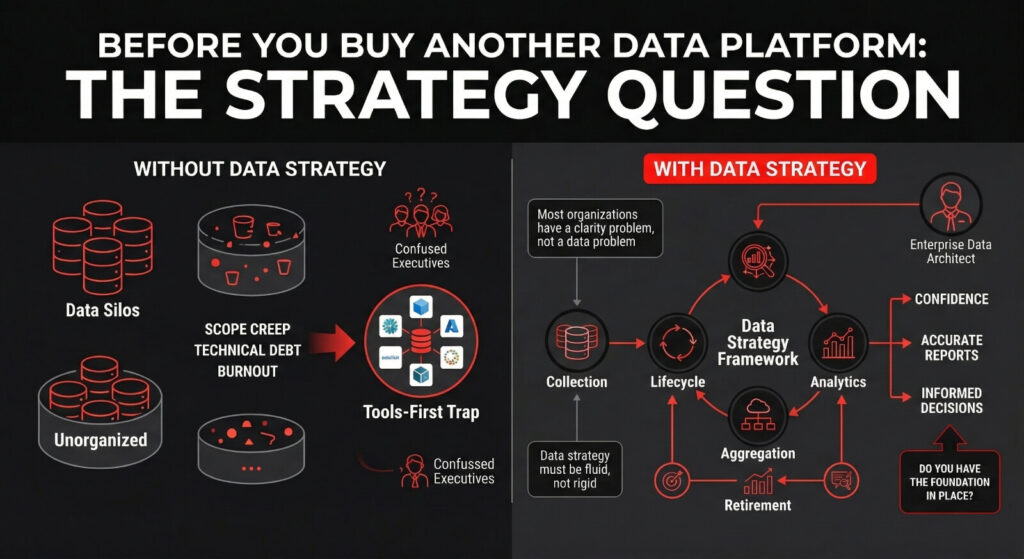
Most organizations don’t have a data strategy problem—they have a clarity problem. When executives ask “what is data strategy,” they’re often confusing it with something else entirely: the platforms they’ve purchased, the dashboards they’ve built, or the data silos scattered across departments.
Data strategy is the overall goal for data within an organization—how it’s collected, connected, and leveraged to drive decisions. But without understanding what strategy actually means, companies end up stuck between having mountains of data and being unable to act on any of it confidently.
The Tools-First Trap
The most common confusion? Thinking data strategy means buying data platforms. Finance has its systems. Marketing has its tools. Product teams have their own infrastructure. Each department collects data, but none of it connects.
The real issue isn’t the lack of data—it’s that data silos prevent organizations from seeing a complete picture. Systems don’t talk to each other. Even when they do, they lack common keys for tying information together. Without a unified view, confidence erodes fast.
What Data Strategy Actually Is
Think of data strategy as connective tissue—the framework that links what you have to what you can actually do with it. It’s understanding what data exists, how it’s acquired, how it connects across platforms and domains, and how to make sense of it all. True strategy includes five critical components:
- Data collection – How information enters the system
- Data lifecycle – How data flows through the organization and when it phases out
- Aggregation and summarization – How raw data becomes usable
- Analytics and insights – How analysis turns into action
- Data retirement – When and how to phase out outdated information
Data strategy must be fluid, not rigid. When strategies become too explicit or finite, they become brittle—and one broken piece erodes confidence in the entire system.
Why Modern Tools Still Fail
Vendors promise amazing platforms with powerful capabilities. What they don’t emphasize is this: if data isn’t well organized, if there’s no clear strategy around collection and aggregation, these tools become nearly impossible to implement effectively.
An overwhelming number of organizations have data that’s poorly organized. Modern platforms assume structured, clean, organized data that most companies simply don’t have. Without that foundation, even the most sophisticated tools can’t deliver value.
When data remains unstructured or fragmented, repeatable reporting processes become problematic. Teams waste time investigating data quality issues that should already have monitoring and auditing built in. This cascades: when analysts can’t trust the data, they second-guess every report. When clients see inconsistencies, confidence in the organization degrades.
The Cost of Buying Before Building
Purchasing data platforms before establishing a clear data strategy introduces serious risks:
Scope creep becomes inevitable. Without defined data lifecycle standards or authoritative sources for data elements, requirements constantly shift. Teams spend excessive time identifying and re-identifying what constitutes the “source of truth” for basic elements like email addresses or subscriber keys.
Technical debt accumulates fast. As scope expands, lower-priority items get pushed to the backlog indefinitely. Eventually, there’s so much debt that no one has the bandwidth to address it.
Burnout hits teams and entire organizations. Companies often implement only a fraction of what they’re paying for because they underestimated the effort required to consolidate, clean, and organize data to achieve high referential integrity. The platform didn’t fail—the lack of data strategy did.
What Executives Should Ask First
Before making any data investment, executive teams should ask: What are our organizational goals, and how does this investment directly support them?
Start with objectives—usually revenue-driven. To increase sales, you need awareness. To drive awareness, you need to understand your customer base. But can you actually answer the critical questions? Are these the right people? Are they interested? Is this a one-time purchase, requiring constant acquisition campaigns?
Identify the pain points preventing goal achievement. Is it lack of data? Lack of data strategy? Then outline initiatives that solve those specific pain points.
The Strategic Roadmap You’re Missing
Without a strategic roadmap, organizations risk creating data “fiefdoms”—isolated environments where teams manage data to solve their immediate problems without considering enterprise-wide reusability. This short-sighted approach limits the value of data across the organization.
The solution? An enterprise data architect with authority to guide the enterprise data strategy. This role sits above individual departments, establishing standards and ensuring data investments serve the entire organization, not just isolated teams.
Building the Foundation
For CMOs and VPs asking whether they have a data strategy, reframe the question: Do you have a marketing plan backed by facts and numbers? Do you have the right data to solve challenges preventing goal achievement?
If the answer is no, start with a data assessment—a deep-dive discovery examining what data you have versus what you need. Compare current state to required state.
Then conduct gap analysis. Do you need a platform to solve connectivity issues? Customer Data Platforms (CDPs) excel at identity resolution, connecting data across data silos to build unified customer views.
But don’t rush to purchase. A data audit should be part of the evaluation process: How ready is the organization to implement this platform? Often, the answer reveals shortcomings in data strategy that prevent leveraging existing platform capabilities—let alone new ones.
The Real Investment
Data strategy isn’t about buying software. It’s about building the framework that makes data usable, trustworthy, and actionable. It’s the missing link between having information and using it to drive real business outcomes.
Organizations with clear data strategy don’t just have data—they have confidence. Confidence that reports are accurate. Confidence that decisions are informed. Confidence that investments deliver value.
Before buying the next platform, ask: Do we have the data strategy foundation in place to make this investment worthwhile? That answer will determine whether your data becomes an asset or just another silo.
About Tandem Theory
At Tandem Theory, we approach data strategy the same way we approach everything else: as a connected system grounded in real insight. That means starting with the right questions (not just more data), aligning sources, governance, and analytics to business goals, and translating it all into a clear, actionable roadmap teams can actually use. If you’re ready for a data strategy that informs decisions—not just dashboards—we’d love to help.