Brand Strategy as a System: How CMOs Turn Brand Positioning Into Action
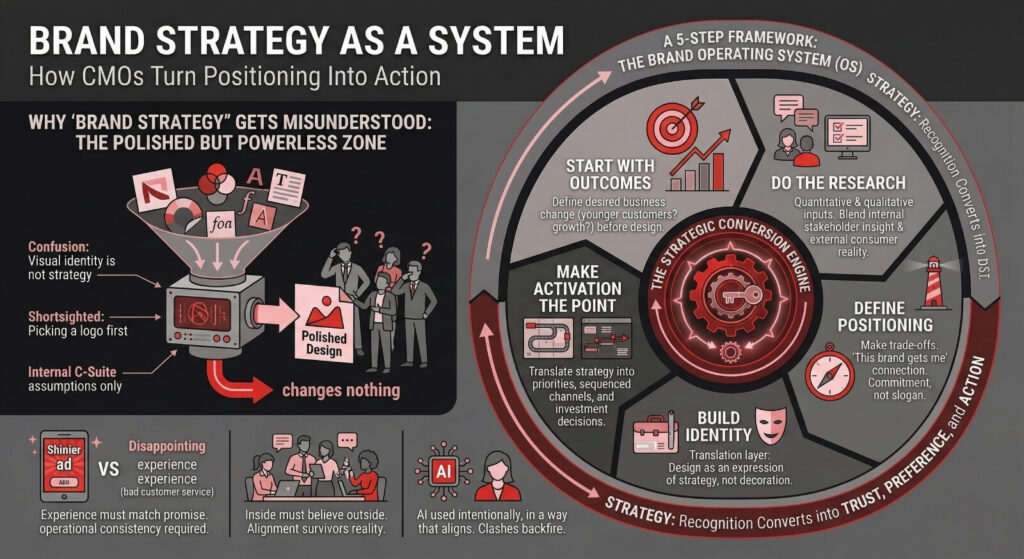
When someone searches how to build brand strategy, they’re usually hoping for something simple: pick a logo, choose a color palette, settle on fonts, write a tagline, and move on.
That expectation makes sense. Visual identity is the most visible part of a brand. It’s also the part that feels easiest to “finish.”
But it’s also where a lot of brand work goes sideways.
Because brand strategy isn’t the logo. The logo is what you get after you’ve done the hard work—the behind-the-scenes decisions that define what the brand stands for, who it’s for, and how it shows up consistently across every touchpoint.
If visual identity is the output, strategy is the operating system.
And without it, even the most polished design can fail to change customer behavior.
This post breaks down a practical, five-step brand strategy framework for building brand strategy as a system—positioning, messaging, and execution working together—so your brand doesn’t just look better, but performs better.
Why “brand strategy” gets misunderstood
A common misconception is that brand strategy is mostly visual: “logo, colors, fonts, tagline.”
That’s brand identity. It’s important, but it’s only one layer.
Brand strategy is what directs everything else—what the brand means, what it promises, who it’s for, and how it creates value. It’s not flashy. It’s not always public-facing. But it’s the part that prevents you from spending money on design and marketing that doesn’t land.
A good way to think about it:
- Visual identity is what people recognize.
- Brand strategy is what makes recognition convert into trust, preference, and action.
A 5-step framework for building brand strategy as a system
Step 1: Start with outcomes, not aesthetics
The fastest way to undermine brand strategy is to start with “what should it look like?”
The better starting question is: what business outcome should the brand enable?
Most brand challenges aren’t really “we need a new logo.” They sound more like:
- “Our current customer base is aging.”
- “We need to attract younger customers for long-term growth.”
- “We need to understand what people think of us today—and what we could mean to them.”
That’s a strategy problem. Design might be part of the solution, but it isn’t the problem statement.
When you begin with outcomes, you avoid the trap of hoping a visual refresh will magically change perception.
Step 2: Do the research you don’t want (but need) to do
If teams shortcut anything in brand strategy, it’s this.
Brand research is the part that feels slow. It delays the “fun” work. It can be uncomfortable because it reveals hard truths.
It’s also the part that prevents you from building a brand on internal assumptions.
A strong approach blends quantitative and qualitative inputs to reduce gaps, validate decisions, and create stronger buy-in—especially when recommendations need to hold up across leadership teams, boards, or distributed organizations.
Two critical inputs matter here:
- Internal stakeholder insight: your team lives the brand every day.
- External consumer reality: customers and prospects experience it completely differently.
If you stop at the “C-suite view,” you risk building a strategy that sounds right in a conference room but doesn’t match the market.
Step 3: Define positioning that actually creates choices
Brand positioning isn’t a slogan. It’s a commitment.
It answers questions like:
- What do we stand for?
- Who are we for (and not for)?
- What do we want to mean to people?
- What do we want them to feel?
- What pillars are we willing to build around?
- What values will show up in how we operate—not just how we advertise?
This is where many brands get nervous—because real positioning requires tradeoffs.
Brands that try to be for everyone often end up resonating with no one. You can’t build deep loyalty without a point of view.
Yes, taking a stance can mean losing some potential customers. But it also creates the conditions for a stronger “this brand gets me” connection with the people you’re actually trying to win.
Step 4: Build identity as an expression of strategy (not decoration)
Once brand positioning is clear, brand identity becomes easier—and more effective—because it’s no longer guesswork.
Now you’re designing an expression of something real:
- The personality you want to project
- The credibility you need to signal
- The emotional tone you want customers to associate with you
This is also where many brands get stuck in the “polished but powerless” zone: they build something beautiful that isn’t anchored to real insight or a clear stance, so it looks great… and changes nothing.
Brand identity should be a translation layer: it turns strategy into signals customers can actually perceive.
Step 5: Make activation the point—not an afterthought
A lot of agencies stop at guidelines.
That’s where brand strategy becomes a document instead of a decision-making tool.
The difference is the action plan—the “so what are you going to do with this?” layer.
Brand activation should translate strategy into priorities and sequencing, like:
- Who are the most important targets right now?
- What journey do we need to guide them through?
- Which channels actually matter based on how they decide?
- What messaging do they need at each stage to build trust?
- What can we realistically accomplish in Phase 1 vs. Phase 3?
This also comes with a reality check: meaningful brand change often takes time. In some cases, the brand roadmap can span years, especially if building trust, expanding awareness, or changing operational experience are part of the work.
Activation turns strategy into investment decisions.
It’s also where marketing strategy becomes an output of brand strategy—because once you know who you are and who you’re for, you can choose the right channels, experiences, and messaging instead of spreading dollars everywhere.
Why polished brands fail in the real world
If you’ve ever experienced a brand that looks premium but feels disappointing, you’ve seen this in action.
Two common failure modes show up again and again:
The experience doesn’t match the promise
A brand can look “shiny” in ads, but if the actual brand experience doesn’t deliver—customer service, follow-up, product quality, operational consistency—trust erodes fast.
The inside doesn’t believe the outside
Especially for service brands, employees are the brand. If the internal culture isn’t aligned, the brand promise won’t survive contact with reality.
Strong brands aren’t only communicated. They’re operationalized.
A quick note on AI and brand strategy
AI is becoming a real point of tension: consumers are increasingly exposed to AI-driven interactions—sometimes without realizing it—and many are developing a sharper sensitivity to authenticity.
The takeaway isn’t “don’t use AI.” It’s simpler:
Use AI intentionally, and in a way that aligns with your brand and your audience’s expectations.
If AI is used to make the experience better, more helpful, or more imaginative (without pretending to be something it’s not), it can fit.
If it feels like automation for laziness—or like a shortcut that tries to manufacture human emotion—it can backfire, especially if it clashes with how people perceive your brand.
The real job of brand strategy
Brand strategy isn’t a mood board. It’s not a deck you admire once and file away.
It’s a brand strategy system that should help you answer, quickly and consistently:
- Should we pursue this audience?
- Should we say yes to this partnership?
- Should we invest in this channel?
- Should we launch this product?
- Should we redesign this experience?
- Should we automate this touchpoint?
When brand strategy is done right, the brand doesn’t just look better. It becomes easier to lead, easier to market, and easier for customers to trust.
And the logo finally has something real to stand on.
About Tandem Theory
At Tandem Theory, we build brand strategy the way serious growth teams build anything durable: as a system, not a style exercise. That means starting with brand research (not assumptions), making real brand positioning choices, expressing those choices through brand identity, and translating it all into a practical brand roadmap your teams can execute. If you’re ready for a brand strategy that guides decisions, prevents wasted spend, and turns your brand into a growth engine—not just a design refresh—we’d love to help.