Marketing in the Age of AI Search: How Generative Overviews Are Rewriting SEO Rules
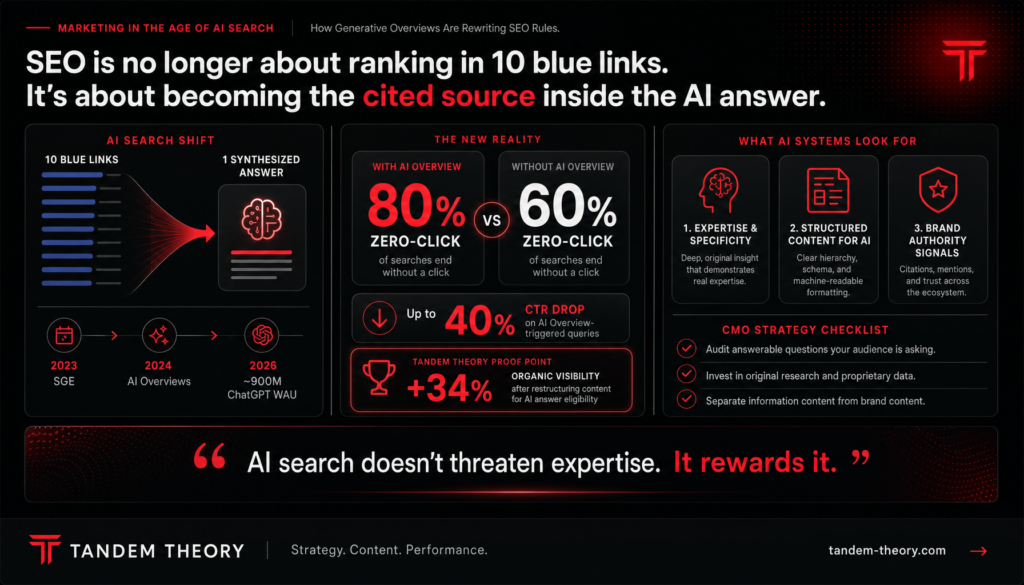
Something significant happened to search in 2023, and most marketing organizations are still catching up. That’s right, in 2023 Search Generative Experience (SGE) was launched.
Google’s AI Overviews, which was introduced in 2024 didn’t just add a new feature to search. They changed the fundamental question that search optimization is trying to answer. For twenty years, the question was: how do we get our link in front of the user? Today, the question is increasingly: how do we become the source that AI trusts when it synthesizes an answer?
Within search the foundations are similar, they both have different victory conditions and ways to best answer the question.
Welcome to the world of generative search, where ranking on page one no longer guarantees you a single click.
What AI Search Actually Changed
When a user asks a question, Google’s AI reads across multiple authoritative sources and synthesizes a direct answer, complete with citations. The same pattern is playing out across LLM search platforms like ChatGPT search and Perplexity, both of which lean on retrieval-augmented generation (RAG) to pull from live web content rather than relying solely on training data.
The data backs up what marketers are already feeling. According to Semrush’s 2025 AI Overviews study, queries that trigger an AI Overview see a median zero-click search rate of roughly 80%, compared to about 60% for queries that don’t. Separate research from BrightEdge found click-through rates on AI Overview-triggered queries dropping by as much as 40% compared to traditional results pages. This is real, and it’s accelerating.
But the flip side matters equally: the brands whose content gets cited gain a form of visibility and authority that didn’t exist before. Being the source Google’s AI trusts, or the source ChatGPT search and Perplexity point to, is a powerful position. One Tandem Theory client in the home services space saw a 34% increase in organic visibility after we restructured its content for AI answer eligibility, a lift driven almost entirely by earning more cited placements in generative search results rather than by climbing traditional rankings.
The New Definition of Ranking
Ranking used to mean positions one through ten. In AI-augmented search, what some practitioners still call the search generative experience (SGE), “ranking” increasingly means being included in the synthesized answer: as a cited source, as the authority on a specific claim, as the brand the model associates with a given topic.
You’re no longer optimizing for ten available positions. You’re optimizing to be among the small number of sources an AI system considers authoritative enough to cite. That’s a narrower gate, and the criteria for passing through it differ from classic page-rank optimization. This is the heart of what’s now called answer engine optimization (AEO): earning a place inside the answer itself, not just a link beside it.
Adoption of AI-powered search keeps climbing. ChatGPT alone reported roughly 900 million weekly active users in early 2026, and a growing share of those sessions function as search sessions. Ignoring that audience because it doesn’t show up in Google Search Console is no longer a defensible strategy.
What AI Systems Are Looking For
Demonstrated expertise and specificity. Generic content doesn’t get cited. AI systems prefer content that says something concrete and accurate rather than summarizing what’s already widely known. For our clients, this has meant a shift away from broad informational posts toward deeper, more opinionated content reflecting genuine organizational expertise.
Structured content for AI. Structure matters more than ever. Content that buries key points in dense paragraphs is harder to parse than content using clear headers, direct declarative sentences, and explicit answers to the questions users are asking. Writing structured content for AI and writing clearly are largely the same discipline.
Brand authority signals. AI systems evaluate the reputation of the source, not just individual pieces of content. Being cited by other authoritative sources feeds directly into the trust signals AI search draws on, making investment in PR, thought leadership, and industry recognition tied to search visibility in ways it never was before.
Practical Strategy Adjustments for CMOs
Audit your content for answerable questions. Does your highest-traffic informational content directly answer what users are asking? Make the answer easy to find: in the introduction, in the headers, in structured data markup.
Invest in original research. Proprietary data, surveys, and industry benchmarks give other sources something to cite that they can’t find elsewhere. We’ve consistently seen this accelerate both traditional backlink acquisition and AI citation rates, the modern equivalent of earning cited sources in AI answers.
Separate your information content from your brand content. In the AI search era, not all content serves the same function. Be intentional about which pieces earn search visibility versus build brand affinity, and don’t ask one piece to do both jobs.
The Bottom Line
The brands most resilient to AI search disruption are the ones who’ve built genuine expertise, distinctive perspective, and real authority in their categories. AI search doesn’t threaten expertise. It rewards it more efficiently than the old algorithm ever did.
The question isn’t whether your brand will survive generative search. It’s whether your content strategy is built on something that deserves to.
AI search doesn’t threaten expertise, it rewards it. The brands that win are the ones built on real authority, and that’s exactly where Tandem Theory works. Humans + technology, turning your expertise into the answer AI trusts. Ready to become the cited source? Let’s Talk →