Passing the Test: A Plain-English Guide to Core Web Vitals
The problem: “Core Web Vitals” sounds technical—so teams treat it like a technical problem
Most marketers hear Core Web Vitals and mentally file it under “web KPIs.” That usually turns into tracking big numbers: site visits, time on page, maybe a few engagement metrics. The reporting looks clean. The dashboards fill up.
And yet, the business still asks the same uncomfortable question: “We’re getting traffic… why isn’t it converting?”
That’s the gap.
When performance is framed only as a technical scorecard, it’s easy to miss how the website supports the larger business—especially in organizations where e-commerce is only one part of revenue and there are physical locations, sales teams, or offline conversions in the mix. The website can still be doing real work: shaping perception, supporting other channels, and removing friction from the path to purchase. But if no one is translating performance into business impact, it gets deprioritized.
A product owner’s advantage is being able to bridge those worlds. You don’t need to “speak code.” You need to connect the website experience to revenue impact.
So, what are Core Web Vitals—in plain English?
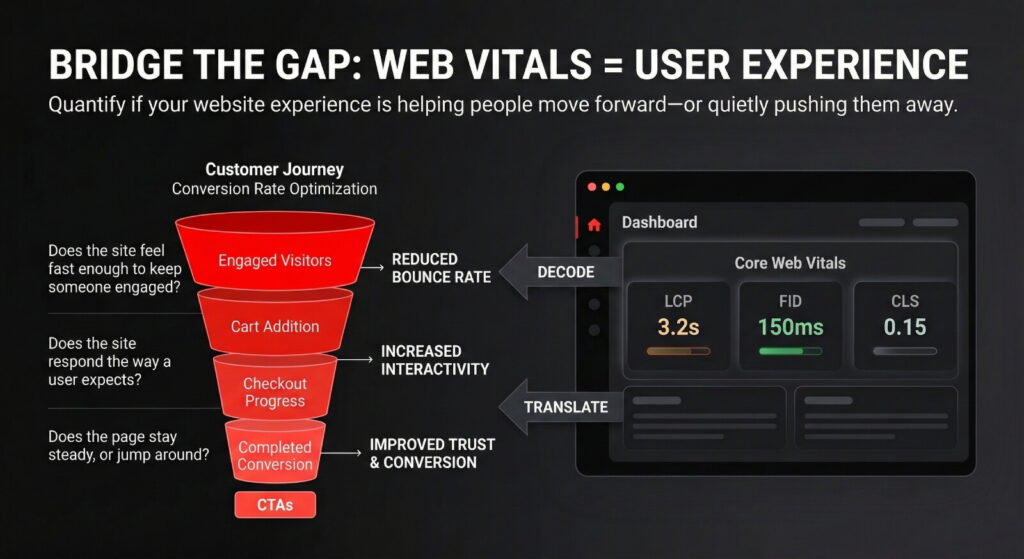
At the simplest level, Core Web Vitals are key Google metrics that measure user experience across three categories:
- Loading: does the site feel fast enough to keep someone engaged?
- Interactivity: does the site respond the way a user expects as they try to do something?
- Visual stability: does the page stay steady, or does it jump around while people read and tap?
That’s it. No mystery.
The practical takeaway is even simpler: Core Web Vitals are a way to quantify whether your website experience is helping people move forward—or quietly pushing them away.
The translator move: stop reporting “numbers,” start reporting “meaning”
One of the fastest ways to make Core Web Vitals useful is to change how you communicate web performance to non-technical stakeholders.
Start high-level, then contextualize.
For example, instead of leading with an unfamiliar metric name, begin with something everyone understands:
- “Here’s how many people came to the site.”
- “Here’s what percentage took the action we care about.”
- “Here’s where they dropped off.”
Then translate technical language into normal language. A “session” becomes “someone visiting your site one time.” A drop-off becomes “a step where customers abandon the process.” A high bounce rate becomes “people are leaving quickly instead of engaging,” which can be a signal that the experience isn’t meeting expectations—sometimes because the site is slow or frustrating.
This isn’t dumbing things down. It’s making the data usable.
If you only track one thing, track conversion rate
For product owners, the most defensible place to anchor a performance conversation is conversion rate—especially for e-commerce.
Why? Because it answers the real question: once someone reaches your site, is the experience set up in a way that’s favorable for purchasing (or completing whatever your primary conversion is)?
You can drive traffic all day long. But if the site experience is causing friction, the business doesn’t have a traffic problem. It has a conversion problem.
And here’s the key: Core Web Vitals matter most when they show up as real friction in the journey.
A practical diagnostic path when conversion is low
When conversion rate is underperforming, the instinct is often to blame marketing: the audience is wrong, the creative is wrong, the offer is wrong. Sometimes that’s true. But a product owner needs a clearer first pass before the organization starts thrashing.
A clean way to approach it:
1) Look at conversion rate by channel mix
Start by asking: are we seeing the problem everywhere, or in specific traffic sources?
If people who arrive through direct traffic convert at a meaningfully different rate than people driven by paid media, that’s a clue. Direct visitors often have higher intent. Paid traffic might be bringing in a colder audience—or it might be exposing an on-site experience problem you didn’t notice because high-intent users are more willing to tolerate friction.
This is also where you should look at bounce rate differences by channel. If paid traffic has a much higher bounce rate than direct, you may have a mismatch problem (wrong audience/message) or an experience problem (people don’t stick around long enough to even engage).
2) Walk the on-site customer journey and find the abandonment point
If conversion is low across channels, stop debating acquisition and start mapping the journey: what steps must a visitor complete to reach purchase (or submit a lead)?
Then identify where they abandon:
- Is there a specific step that feels too difficult?
- Is there confusion, excessive friction, or broken expectations?
- Are people dropping at a moment where speed, responsiveness, or page stability would matter most?
This is where Core Web Vitals become actionable—because you’re connecting experience quality to a measurable loss point in the funnel.
Why Core Web Vitals (and web stats) get deprioritized—even when they’re hurting performance
In the real world, two things cause web performance to fall to the bottom of the list:
Teams don’t see how website performance impacts the bottom line
If online ordering or online conversion is only a small slice of revenue, performance work can feel like “nice to have.” The fix isn’t arguing harder. It’s reframing: how does the website support broader business objectives and other channels? Where does it remove friction? Where does it create it?
Teams don’t trust the data
If GA4 (or your analytics setup) is implemented incorrectly—bad tagging, broken tracking, inconsistent definitions—people stop believing what they see. And when the data isn’t trusted, it isn’t used. Performance work becomes opinion-driven instead of evidence-driven.
In both cases, the solution is the same product-owner muscle: establish credibility and connect the work to outcomes.
The leadership question that unlocks investment
If leadership wants to justify investment in improving Core Web Vitals, don’t start with “How do we raise our scores?”
Start with a revenue question:
How do we improve the customer experience to increase conversion rate—or, if we truly can’t improve conversion right now, how do we drive more qualified traffic to generate more revenue anyway?
That question forces prioritization. It ties performance work to business intent. And it also makes the tradeoffs visible: if you know conversion is capped because the experience is poor and there are no resources to improve it, then the business is choosing a path where the only lever left is volume. That’s an expensive way to grow.
Choose a “source of truth” for performance
When performance conversations hit revenue, media platforms will happily claim credit. The problem is that platforms are incented to overstate their impact. If you’re trying to connect web performance to revenue, your ultimate source of truth should be whatever internal system the company uses for financial reporting.
Web analytics can be a strong measurement layer, but it won’t perfectly match financial reporting. The goal isn’t perfect alignment. The goal is consistent, trusted measurement that leadership can act on.
About Tandem Theory
At Tandem Theory, we approach Core Web Vitals the same way we approach any serious growth initiative: as a business performance lever, not a technical score to chase. That means translating web metrics into what stakeholders actually care about—conversion rate, drop-offs in the customer journey, and revenue impact—then prioritizing fixes based on where the experience is limiting growth. If you’re ready to bridge the gap between developer effort and business outcomes, build trust in your data, and treat website performance like an asset that compounds over time, we’d love to help.