Predictive Analytics in Marketing: The Practical Guide to Lower Customer Acquisition Cost
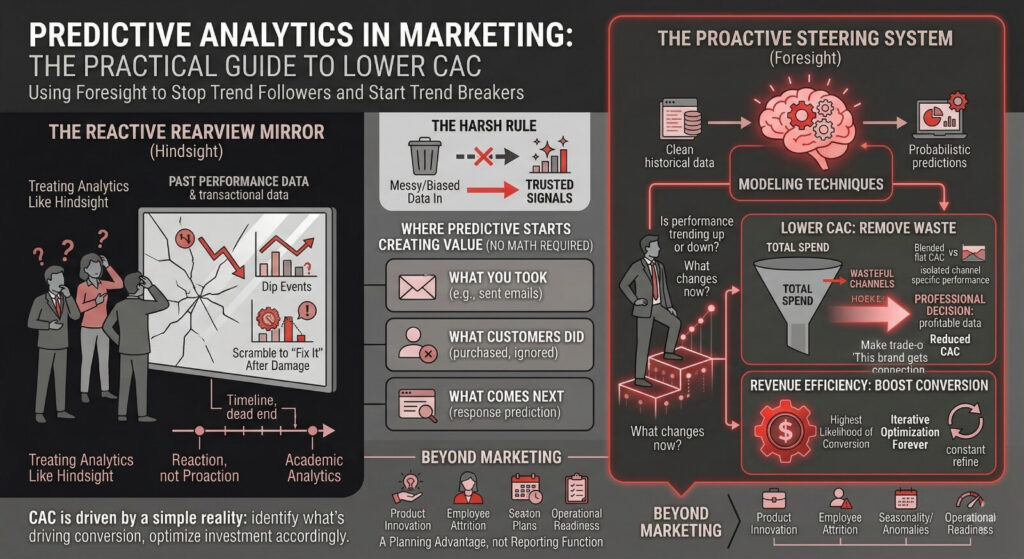
Most teams treat analytics like a rearview mirror.
A dashboard tells you what happened last week. A report explains why performance dipped. Then everyone scrambles to “fix it” after the damage is already done.
Predictive analytics is how you stop operating that way.
It’s the shift from hindsight to foresight—using what you already know (historical performance and transactional data) to predict the next likely action or outcome, and to decide what to do before trends become problems.
And when it’s used correctly, it doesn’t just produce forecasts. It lowers customer acquisition cost (CAC), improves conversion, and makes every dollar work harder.
The simplest definition of predictive analytics (no math required)
At its core, predictive analytics sits inside the broader analytics family. It uses past behavior—historical performance data and transactional patterns—plus modeling techniques to predict what comes next.
A straightforward way to think about it:
You look at what actions you took (emails sent, offers delivered, channels funded).
You compare that to what customers did (purchased, didn’t purchase, responded, ignored).
And you build a way to predict which combinations are most likely to create the outcome you want.
For marketing teams, that often means predicting response: which tactic, to which customer type, is likely to drive what kind of action.
Where predictive analytics starts creating real value for marketing teams
Here’s the twist: the value isn’t only in knowing what to do.
It’s in knowing what not to do.
Marketing is a game of options. You have a long list of tactics that could theoretically work. Predictive analytics helps you narrow that list based on what actually performs—so your team can stop spending time and budget on low-impact activity.
When applied well, it supports iterative optimization forever. You’re not running a campaign, learning once, and moving on. You’re constantly refining what works, what doesn’t, and what to adjust next.
That’s how marketing teams move from reactive reporting to proactive decision-making.
The fastest path to lower CAC: use predictive analytics to remove waste
CAC is driven by a simple reality: you add up the spend required to acquire customers.
That spend typically spans a mix of channels—upper-funnel and lower-funnel—and each comes with different costs. Lower-funnel channels often cost more because they’re closer to conversion, but they don’t always deserve the credit they get.
This is where predictive analytics becomes practical.
Instead of spreading investment across everything because it “might” contribute, you use historical performance to identify channels that have very little impact on converting customers—and you remove or reduce them.
If a channel isn’t contributing meaningfully to conversion, keeping it in the mix inflates CAC. Cutting it reduces total spend required to acquire customers. And that’s how data becomes profitable: fewer dollars spent to achieve the same outcome.
Predictive analytics isn’t just for marketing
Marketing is the most obvious use case, but predictive thinking can improve other parts of the business too.
It can help anticipate what products customers are most likely to adopt—informing product innovation. It can be used to understand employee attrition by identifying patterns that correlate with people leaving. It can also be used to forecast seasonality and even pinpoint anomalies—specific situations where a major moment might outperform the usual “gold standard” season.
Those forecasts don’t just make for interesting charts. They shape operational readiness: staffing, inventory, and delivery systems that can support demand when it spikes.
The big idea: predictive analytics isn’t a reporting function. It’s a planning advantage.
What separates profitable teams from “academic analytics”
Many teams stop at dashboards.
They look at results and react. “We did well.” “We did poorly.” End of story.
Teams that use predictive analytics to drive profitable decisions do something different: they anticipate.
They ask:
- Is performance trending up or down over the next few weeks?
- Is that trend still within what we expected—or is it breaking?
- What changes should we make now to alter the trajectory?
This is the difference between trend followers and trend breakers.
It’s also why predictive analytics is a leadership capability, not just a technical one. The teams that win aren’t only measuring. They’re steering.
The first use case to focus on if you want revenue efficiency
If the goal is revenue efficiency, the first use case is simple:
Start with conversion.
Ask: if you only had one dollar, where would you invest it to get the highest likelihood of conversion?
Because if revenue is the goal, conversion is the engine.
There’s a second layer here too: if your broader goal is profitability, then CAC becomes the lever. But the foundation is still the same—identify what’s driving conversion, then optimize investment accordingly.
What happens when teams apply predictive analytics too broadly
This is a common failure mode: teams try to apply predictive analytics everywhere at once. More data. More channels. More complexity. More theory.
And the result is often… nothing changes.
When predictive analytics is applied too broadly, CAC tends to remain stagnant and flat. Why? Because you’re working with a large base of averages. The more you throw into the mix, the more results get diluted. You end up with one blended CAC that doesn’t tell you which channels are efficient and which are wasteful.
The fix is focus.
Use predictive analytics to isolate channel-specific performance, then reallocate toward what actually drives conversion at an efficient cost.
But don’t fall into the other trap either: being so efficient you lose scale.
There’s a real balance between a healthy CAC and the volume required to support the business. Efficiency without volume doesn’t hit revenue. Volume without efficiency burns budget.
Predictive analytics is how you find the balance.
The caveat that decides whether predictive analytics works
Predictive analytics has a harsh rule: bad data in, bad data out.
There’s also a tempting myth that “more data means a better model.” Not always.
If you include messy, unrelated, or biased data, the model can become less reliable. If different types of transactions are mixed together (for example, distinct ordering behaviors rolled into one bucket), you can accidentally create false “signals” that mislead decisions.
Predictive analytics works best when the input data is clean, accurate, and structured in a way that reflects reality.
That’s what makes the outputs actionable—because they’re based on patterns you can trust.
About Tandem Theory
At Tandem Theory, we approach predictive analytics the same way we approach any serious growth initiative: as a decision engine, not a forecasting exercise. That means starting with clear outcomes like conversion and CAC, using historical performance to identify what to stop doing, and building models on clean, trustworthy data so the recommendations hold up in the real world. If you’re ready to make data profitable—lowering customer acquisition cost while protecting the volume your business needs—we’d love to help.