RevOps Is Not Just a Buzzword: Aligning Sales, Marketing, and Customer Success Around Revenue
Revenue Operations “RevOps” sounds revolutionary on LinkedIn. In practice, it usually looks like three departments debating a spreadsheet.
Our take: underneath the jargon is one of the most structurally important ideas in go-to-market strategy of the past decade and one of the most misunderstood. Here’s what it is, why marketing leaders need to champion it, and what the first 90 days look like.
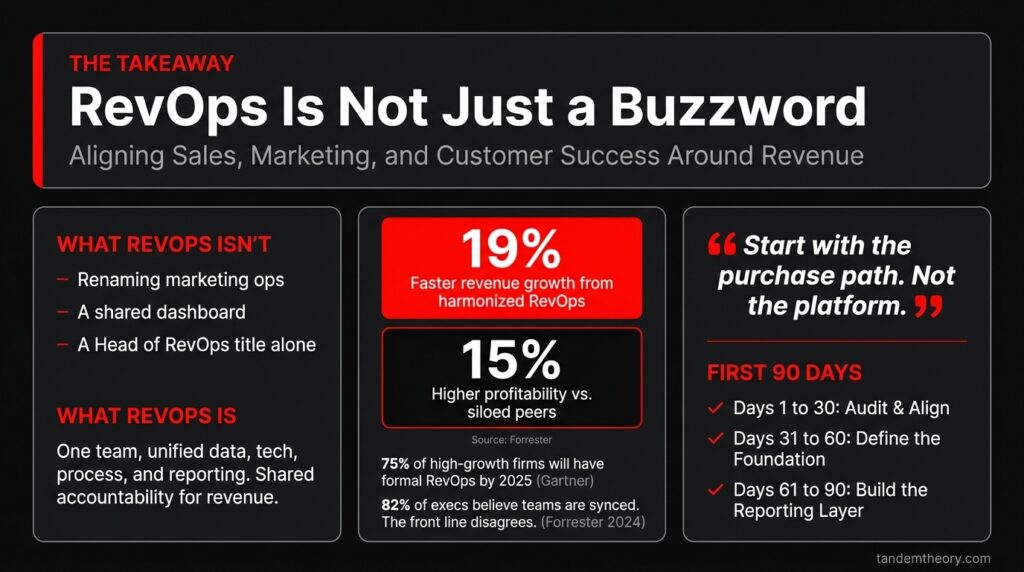
The numbers, up front: Forrester found that organizations who successfully harmonize revenue operations see a 19% acceleration in growth and a 15% boost in profitability compared to peers still stuck in silos.
What RevOps Actually Is (And Isn’t)
Let’s clear the fog first. RevOps is not:
- Renaming your marketing ops team
- A shared Salesforce dashboard
- Hiring a Head of RevOps and hoping organization silos dissolve
RevOps is a structural operating model that unifies the data, technology, process, and reporting behind sales, marketing, and customer success, under one team with shared accountability for revenue.
The insight is simple: siloed go-to-market teams create siloed data, siloed metrics, and siloed customer experiences. Marketing measures Marketing Qualified Leads. Sales measures pipeline. Customer Success measures Net Promoter Scores. Each team optimizes for its own number, and none is fully accountable for the revenue outcome all of them influence. Everyone’s chasing their own scoreboard. Nobody owns the revenue all three are supposedly working toward.
Why Marketing Leaders Need to Champion This
Most RevOps conversations start in the Chief Revenue Officer’s office. But don’t get hung up on the exact title or assume a particular size of the organization. The organizations that implement it most successfully are the ones where the marketing leader is an active champion.
Here’s why: every revenue outcome starts with a decision marketing makes first, such as the Ideal Customer Profile, lead scoring, messaging. All of it has downstream consequences for how efficiently sales closes and CS retains.
If marketing’s data isn’t integrated with sales and Customer Success, marketing never learns whether any of it paid off. You’re optimizing in the dark.
The stakes, in two data points:
- Gartner estimates three-quarters of leading high-growth firms will have a formalized RevOps framework by 2025. This has quietly graduated from “interesting idea” to “table stakes.”
- Forrester 2024 data found 82% of B2B executives believe their departments are perfectly synchronized. Ask whoever’s actually managing the handoffs, and you’ll hear a very different story.
That gap between leadership and the front line is exactly why marketing needs to be the one closing it.
The Four Components of a Functioning RevOps Model
- Unified data architecture. Advocate for a single source of truth for customer and prospect data, connected across CRM, marketing automation, customer success, and financial systems.
- Shared process design. Standardize definitions and handoffs across the funnel: what counts as an MQL, what triggers a sales handoff, what qualifies an opportunity. Everyone’s on the same page.
- Integrated technology governance. Put one team in charge of go-to-market tech stack decisions and stop paying for redundant tools. This outcome provides an early win.
- Cross-functional performance reporting. Report revenue metrics at the funnel level, and measure marketing, sales, customer satisfaction against the same shared outcomes, not separate victory laps. Ensure that the process includes key takeaways, actionable insights, and organizational buy-in. The optimal reporting process provides continuous improvement insights and customer focus.
What the First 90 Days Actually Look Like
Days 1–30 Audit and Align. Map the go-to-market process from first touch to renewal. Find every place data gets created, transformed, or dropped during a handoff. Get marketing, sales, and CS leadership to agree this is a shared initiative, not a project one department is doing to the others. This is the step teams skip. It’s also the one that costs them the most later.
Days 31–60 Define the Foundation. Agree on shared definitions: MQL criteria, opportunity stages, customer health scoring. In most organizations we work with, sales and marketing “debate” about what an MQL is even when both teams believe they’re operating off the same definition. Pressure-test the current technology stack: what’s integrated, what’s siloed, what’s quietly duplicated and draining budget.
Days 61–90 Build the Reporting Layer. Before restructuring teams or changing processes, build the reporting infrastructure to measure whether changes work. A shared revenue dashboard visible to marketing, sales, and CS simultaneously creates accountability and gives you the baseline to prove impact later.
The Long Game
A full RevOps transformation typically takes 12 to 18 months to stabilize. That’s a commitment for most organizations. But, the organizations that commit to it consistently outperform on:
- Pipeline predictability
- Sales cycle length
- Customer retention
- Marketing spend efficiency
RevOps isn’t a buzzword. It’s the operating model that makes modern go-to-market actually work the way everyone already claims it does.
If you’re ready to trade siloed metrics for a unified revenue architecture, let’s build it together. Reach out to Tandem Theory.