The 2027 Marketing Plan Most Brands Will Get Wrong
By now, your team is knee-deep in planning next year. By February, you’re defending the annual plan in a conference room. By June, you’ve quietly stopped opening the file.
Nobody decides to abandon it. A platform changes its rules, a competitor does something disruptive, or a budget gets trimmed in a meeting you weren’t in. The plan was built for a world that no longer exists, and updating it would mean admitting that. So the team keeps working, and the plan becomes a document that was true in January.
This isn’t a discipline problem. It’s a design problem.
The Plan Is a Prediction. That’s the Mistake.
Most annual plans are written as forecasts: Here is what we’ll do, here is what it will produce, here is when. A forecast is only useful while the world cooperates. When it doesn’t, you have nothing to fall back on except a meeting about why the plan was wrong.
A better plan is a set of decisions with triggers. It says what you’re committing to, what you’re testing, and what result would make you change course. The plan stays valid after the surprise because the surprise was anticipated, even if its specifics weren’t.
Here are four ways plans fail that test.
Mistake 1: Planning Every Channel at the Same Resolution
Open most plans and every channel gets the same treatment: a goal, a budget line, a monthly cadence, a KPI. Paid search gets twelve months of detail, and so does the experimental channel you’re 20% sure about.
Different parts of your plan have different shelf lives. Your core, proven programs can be planned in detail for the year because you know how they behave. Your emerging bets can’t. Planning them to the same precision is false confidence on paper.
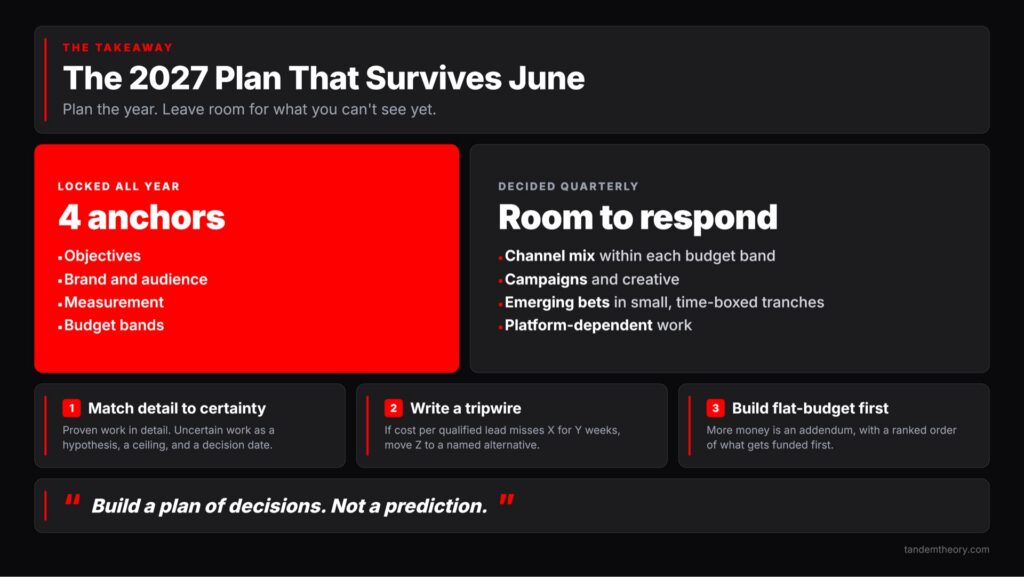
Plan your proven work at high resolution and your uncertain work at low resolution. For the second group, write the hypothesis, the budget ceiling, and the date you’ll decide, not a twelve-month calendar.
Mistake 2: No Tripwires
Ask a team, “What result would make you move money out of this channel?” Most can’t answer, and the ones who can usually answer after the fact.
Without a pre-agreed threshold, a mid-year shift becomes a negotiation. Someone owns the channel. Someone championed the bet. Someone doesn’t want to be the person who says it isn’t working. The data is ambiguous, so the decision slides another quarter.
A tripwire settles that argument in advance, when nobody’s ego is attached to the outcome. It’s one sentence:
If cost per qualified lead on [program] exceeds [X] for [Y] consecutive weeks, we move [Z] of the budget to [named alternative].
You can write ten of these in an afternoon. Do it in the planning meeting, not the crisis meeting.
Mistake 3: Plans That Assume More Money
Most 2027 plans we’ll see this winter were built on a quiet assumption that the budget would be roughly this year’s plus something. For many teams that isn’t the situation. Finance is asking every line to justify itself, and the growth target hasn’t moved.
If your plan only works with an increase, it isn’t a plan. It’s a request.
Build the flat-budget version first. Start with what you have, decide what that money does best, and write it down. Then build the “if we get more” version as an addendum with a clear order of what gets funded first. If the budget comes in short, you’re cutting from a ranked list instead of improvising.
The flat version is also your strongest case when someone asks for proof the existing money is working. You’ve already shown what it’s for.
Mistake 4: Measurement as an Afterthought
Plans specify what you’ll do and then, in a final slide, what you’ll measure. By then, the tracking you needed in Q1 isn’t set up, the baseline you needed doesn’t exist, and the metric you chose can’t be pulled by channel.
Measurement belongs inside each bet, not after it. For every line in the plan, answer three questions before you fund it:
- What would we need to see to call it working?
- Can we actually see that today, or does something have to be built first?
- Who looks at it, and how often?
If you can’t answer the second question, the first work item on that bet is the measurement, not the media. This is also where tripwires get their teeth. A threshold you can’t observe is just a wish.
If You Plan Quarterly, This Works Better for You
Some teams never lock a full-year plan, whether by choice or because the business changes too fast. That’s fine. The failure mode is treating “quarterly” as “we’ll figure it out each quarter.” That’s a series of improvisations.
Split the year into what’s locked and what’s open.
Lock for the year:
- Objectives. What the business needs marketing to deliver.
- Brand and audience foundations. Positioning and core audiences shouldn’t be renegotiated every ninety days.
- Measurement infrastructure. Tracking, baselines, and reporting cadence.
- Budget bands. Ranges per category, not exact line items.
Leave open:
- Channel mix within each budget band.
- Specific campaigns and creative.
- Emerging bets, funded in small, time-boxed tranches.
- Anything dependent on a platform or market condition you can’t see yet.
The locked layer gives you consistency. The open layer gives you room to respond. You’re still planning the year. You’re just not pretending to know the details of Q4 in November.
The One-Page Plan
The plan that survives a mid-year surprise fits on one page. If it takes more than that, nobody will use it in June. It has four parts.
1. Objectives (3 max). What the business needs, stated as outcomes, not activities.
2. Bets. The programs you’re funding, each tagged proven, scaling, or testing. Each gets a one-line reason it earns the money.
3. Tripwires. For every bet, one sentence: the result that would make you shift spend, and where the money goes.
4. Budget bands. A range per category, a flat-budget baseline, and a ranked list of what gets funded first if more arrives or what gets cut first if less does.
Then put a review date on it. Quarterly is enough for most teams. The review isn’t “is the plan right?” It’s “did any tripwire trip?”
What to Do This Month vs. What Can Wait
It’s already November. Here’s what matters before the holidays, and what doesn’t.
Do this month:
- Write your three objectives and get internal alignment.
- Build the flat-budget baseline. This is the hardest part and the one most worth doing early.
- Audit your measurement. Identify which bets you can’t currently measure, and start fixing that.
- Draft tripwires for your largest programs, since that’s where a miss costs the most.
Wait until January:
- Detailed campaign calendars and creative briefs.
- Channel-level monthly targets for anything tagged testing.
- Final budget allocations, if finance hasn’t locked the number.
- Polish. A rough one-page plan that exists beats a refined one that doesn’t.
A plan that’s 70% done and honest about what’s open will serve you better than a finished plan that assumes the world holds still.
The Test
When you finish your 2027 plan, ask one question: what happens when something goes wrong in June?
If the answer is “we’ll have a meeting,” the plan is a prediction. If the answer is “we’ll check whether a tripwire tripped and move the money we already agreed to move,” the plan is a set of decisions. Only the second kind is still in use in July.
Want a second read before yours goes to finance? hello@tandemtheory.com