The Retail Media Network Decision: Where Should Your Brand Invest?
There’s a rule in commercial real estate: the three most important factors are location, location, and location. Retail media networks operate on exactly this logic by placing your brand in front of consumers while they’re actively shopping on platforms where purchase intent is the baseline, not the goal.
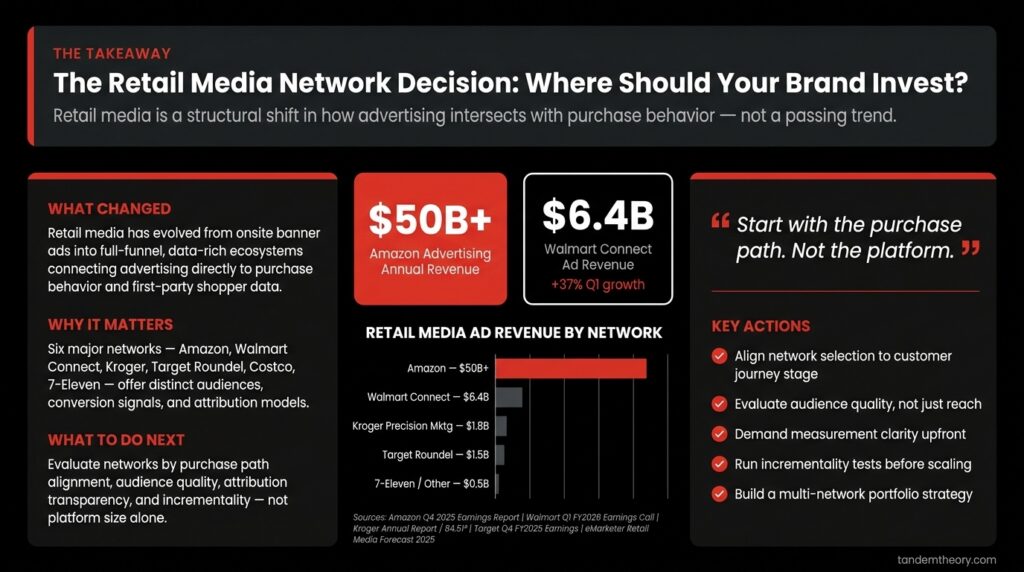
That’s a different advertising proposition from buying attention and looking for conversion. It’s why retail media has become the fastest-growing advertising channel in the market, with Amazon Advertising alone generating over $50 billion annually.
Why Retail Media Is a Structural Shift, not a Trend
Retailers have two things traditional media doesn’t: first-party purchase data and point-of-sale proximity. They know what their customers buy, how often, and in what combinations. Retail Media can place advertising in the exact environment where purchase decisions happen.
For advertisers navigating the collapse of third-party cookies and looking for personalization, this is enormously valuable. Retailer first-party data is among the most purchase-intent-rich data in the advertising landscape, and that advantage only grows as privacy regulations tighten.
Mapping the Major Networks
Amazon Ads is the undisputed market leader. According to eMarketer, Amazon has an estimated 79.7% of ad spend, and its closed-loop attribution connecting ad exposure directly to purchase is strong. For brands where Amazon represents a meaningful share of the purchase path, it’s table stakes. But it can become a gravity well that absorbs disproportionate budget if you’re not disciplined.
Walmart Connect represents a distinct, value-oriented audience with significant geographic reach outside Amazon-dominant markets. They have a reach of approximately 150 million customers who shop at Walmart online and in stores each week. That’s scale. Walmart Connect is delivering strong ad revenue growth, reaching $6.4 billion, up 37% in Q1. For CPG brands, it merits serious evaluation.
Kroger Precision Marketing is compelling for food, beverage, health, and household categories, as 95% of Kroger transactions are connected to their loyalty card. The depth of customer data and the ability to target up to 60 million US households based on actual grocery purchase history is something marketers and their agencies should be paying attention to. They offer a full-funnel retail media solution with an omni-channel view.
Roundel™ Media (designed by Target) reaches a higher-income audience: parents, household decision-makers, and loyal Target Circle members. They also extend reach through a wide network of publisher partners.
Costco has entered retail media cautiously compared with Walmart, Amazon, and Target. Rather than maximizing advertising inventory, Costco emphasizes protecting the member experience. They too, use highly trusted first-party purchase data, built around 135+ million member relationships, but retail media is positioned as an extension of merchandising and not a separate advertising business. Currently, they focus on relevant product discovery instead of overwhelming shoppers with ads.
7-Eleven approaches retail media from the opposite direction, reaching customers during frequent, immediate-consumption shopping occasions across its 13,000 stores and among 12 million daily shoppers. Unlike many other retailers focused primarily on monetizing media inventory, 7-Eleven emphasizes helping brands launch new products, drive trial, increase basket size, and generate measurable incremental sales.
Emerging networks such as CVS Media Exchange, Instacart Ads, and Albertsons Media Collective are growing rapidly. For category-specific brands, these platforms can offer highly relevant audiences with less competition. Over time, there may be consolidation, fragmentation, or a reduction in options, but as of now marketers have plenty to evaluate before they invest.
How to Evaluate Which Networks Fit Your Brand
Start with the purchase path, not the platform. Map your customers’ actual purchase behavior. What percentage of your category sales flow through each retailer? The right retail media investment is a function of where your customers are, not where the most compelling sales pitch comes from.
Assess audience quality, not just size. A specialty retailer with high category penetration and clean purchase data may deliver better results than a mass platform where your audience is a small slice of total traffic.
Demand measurement clarity. Before committing a significant amount of budget to any network, push for specificity about what you’ll be able to measure, in what timeframe, and how attribution works. Example: Amazon will not allow you to track performance with a third-party system, which is standard practice on every other digital media platform, making it a challenge for media professionals and their clients. Asking these questions is both legitimate and increasingly well-received.
Building a Measurement Framework
The central question isn’t “did sales go up?” It’s: “did sales go up because of this advertising, beyond what would have happened without it?” That incrementality question requires holdout testing or media mix modeling.
Retail media also shouldn’t be measured in isolation. The consumer who sees a CTV ad, searches for your brand, and clicks a sponsored product listing at checkout? All touchpoints of a single journey. The best measurement frameworks we’ve built for clients connect retail media exposure data to unified customer journey models that account for cross-channel contribution.
The Bottom Line
Retail media isn’t a tactical play to appease a retailer partner. It’s a structural shift in how advertising intersects with purchase behavior. The brands building systematic, measurement-driven retail media capabilities now are building advantages that compound over time.
In commercial real estate, the best locations don’t stay available forever. The same is true here.
Choosing where to invest in retail media is a purchase-path question, not a platform question, and answering it well takes clean data and honest measurement. That’s exactly where Tandem Theory works. Humans + technology, connecting retail media exposure to the full customer journey so you can see what’s actually driving sales. Ready to map your networks? Let’s Talk →