The Truth About Multi Touch Attribution: Why Perfect Is Impossible—and Still Profitable
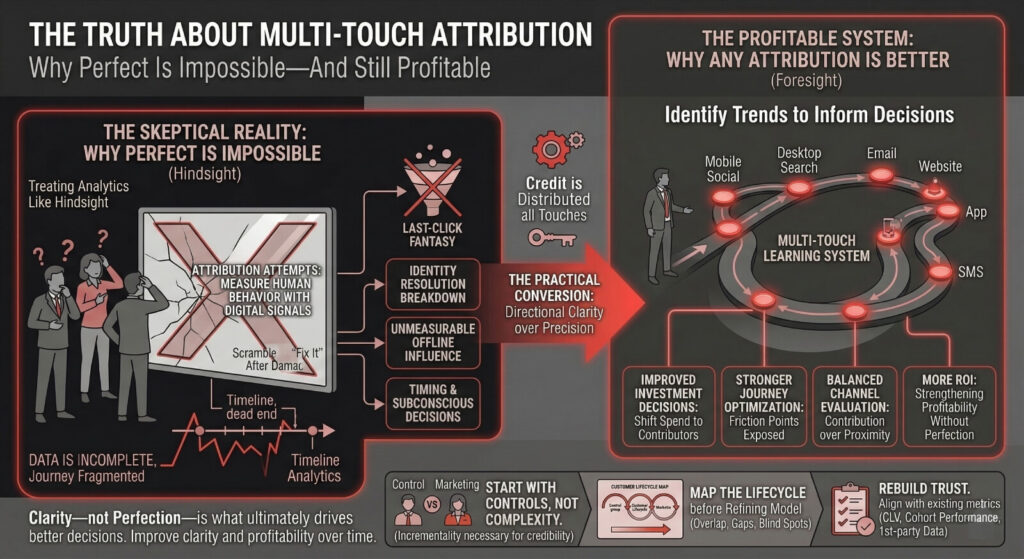
The problem: attribution is expected to be precise— reality is anything but
Analytics leaders are under constant pressure to explain what’s working, what isn’t, and where marketing dollars should go next. Attribution is supposed to bring clarity to those decisions. Instead, it often introduces more confusion.
Different channels report different outcomes. Dashboards don’t agree. And leadership wants certainty from data that was never designed to deliver it.
Here’s the reality most teams avoid saying out loud: perfect attribution does not exist. Customer journeys are fragmented, decisions are influenced by factors outside measurable systems, and data is never as complete as models assume. But acknowledging those limits doesn’t weaken attribution—it makes it more useful.
When approached honestly, multi-touch attribution becomes a practical decision-making tool, not a promise of precision.
Why multi-touch attribution feels so hard in practice
Attribution struggles usually stem from complexity, not incompetence.
Most organizations engage customers across multiple channels—paid media, email, SMS, websites, apps—often within tight timeframes. When conversions happen shortly after several interactions, isolating a single “cause” becomes unrealistic.
Compounding the issue is identity resolution. Without confidently linking individuals across channels, attribution models rely on assumptions. Add inconsistent definitions of conversions, varying lookback windows, and misaligned stakeholder expectations, and attribution becomes a source of debate instead of insight.
The issue isn’t that attribution is broken. It’s that it’s often framed incorrectly.
The limits of last-click attribution
Last-click attribution persists because it’s simple. It assigns all credit to the final interaction before conversion, offering a clean answer to a messy question.
But simplicity comes at a cost.
Last-click attribution routinely:
- Undervalues early- and mid-funnel efforts
- Over-credits channels closest to conversion
- Favors what’s easiest to track, not what’s most influential
As a result, analytics leaders are left defending budgets that don’t reflect how customers actually move through the customer journey.
What multi-touch attribution actually does better
Rather than asking what was the final push, multi-touch attribution asks: how did channels work together?
It distributes credit across interactions to provide a more realistic view of contribution. Not because the model is perfectly accurate—but because it better reflects how marketing operates in the real world.
This shift reframes attribution from a scoring exercise into a learning system.
Why perfect attribution is impossible—and why that’s acceptable
Attribution attempts to model human behavior using digital signals. That limitation alone sets a ceiling on accuracy.
No model can fully account for:
- Offline influences
- Timing and context
- Subconscious decision-making
- Untracked exposure
That’s why attribution outputs should be treated as directional, not definitive.
For analytics leaders, this distinction matters. The purpose of attribution is not to prove causation beyond doubt—it’s to identify trends strong enough to inform better decisions.
How better attribution leads to more profitable outcomes
When teams stop chasing precision, attribution starts delivering value.
Improved investment decisions
Even directional insight helps shift spend toward channels that consistently support conversion and away from those that don’t—strengthening marketing ROI without requiring perfect measurement.
Stronger journey optimization
Attribution reveals which touches add friction—unnecessary messages, poor timing, or redundant communications that hurt engagement.
More balanced channel evaluation
Channels are assessed based on contribution, not proximity to conversion, reducing internal bias and misaligned incentives.
Start with controls, not complexity
The most practical way to strengthen attribution isn’t a new model—it’s a control.
Holding out a portion of the audience creates a baseline that helps validate whether marketing activity is driving measurable impact. Controls bring credibility to attribution by grounding insights in comparison, not assumption.
They don’t need to be large. Even small, statistically meaningful controls can dramatically improve confidence in outcomes—especially for organizations operating at scale.
This is where incrementality moves from “nice-to-have” to necessary.
Map the lifecycle before refining the model
Before optimizing attribution logic, teams need a clear view of the customer lifecycle.
Many organizations underestimate how much communication customers receive across channels. Mapping that lifecycle exposes overlap, gaps, and data blind spots. It also clarifies where attribution inputs originate and where identity resolution breaks down.
Without this foundation, even advanced attribution models risk optimizing against an incomplete picture.
Rebuilding trust in attribution data
Skepticism around attribution is often justified. Vendor overpromises, opaque methodologies, and outdated models have damaged credibility.
Trust improves when attribution aligns with metrics analytics leaders already rely on—such as customer lifetime value, cohort performance, and controlled comparisons. First-party data plays a critical role here, anchoring attribution in signals teams can validate and defend.
In practice, it’s less about picking the “right” attribution model and more about creating measurements that stakeholders believe.
Final takeaway for analytics leaders
There is no universal attribution model. Every organization’s data, channels, and maturity level are different. But one principle holds: any attribution is better than none.
The most effective path forward is incremental:
- Start with available data
- Introduce controls
- Align stakeholders on definitions
- Increase sophistication as confidence grows
Multi-touch attribution isn’t about certainty. It’s about clarity. And for analytics leaders tasked with proving marketing ROI and guiding investment, clarity—not perfection—is what ultimately drives better decisions.
About Tandem Theory
At Tandem Theory, we approach multi-touch attribution the same way we approach any serious growth initiative: as a decision system, not a promise of perfect precision. That means aligning attribution to business outcomes, grounding measurement in first-party data, using controls and incrementality to validate impact, and building models your stakeholders can trust and act on. If you’re ready to move beyond last-click attribution and treat attribution as an asset that compounds—improving clarity and profitability over time—we’d love to help.