Unlocking CTV Performance: 3 Data-Driven Measurement Strategies
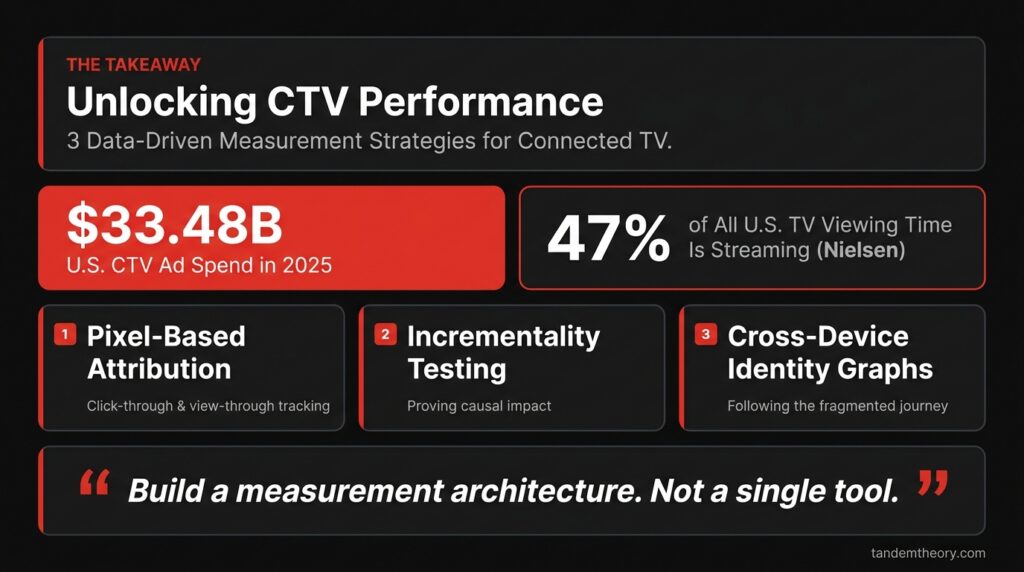
CTV is no longer an experimental line item; with $33.48 billion in U.S. ad spend for 2025, it’s a standard. Yet, measurement remains the biggest barrier to ROI. You don’t need a perfect tool, you need an architecture.
Streaming now accounts for nearly half of all U.S. TV viewing time, according to Nielsen, but the customer journey has become increasingly fragmented. A consumer might see an ad on a smart TV, research the brand on their phone, and convert on a laptop. If you rely on a single measurement source, or struggle with the fragmented standards flagged by the IAB, you are likely leaving ROI on the table.
To capture the full value of your investment, you need a multi-layered strategy. Here are three data-driven approaches to measuring CTV performance, when to deploy each, and what to watch out for.
1. Pixel-Based Attribution: Click-Through and View-Through Tracking
What it is: Places a tracking pixel on your website or app, then matches CTV ad exposures via IP address, device ID, or increasingly server-side conversion APIs to subsequent website visits, form fills, or purchases.
In CTV, most of that matching happens through view-through attribution rather than click-through, because a viewer typically can’t click a linear video ad the way they can click a display banner. A view-through conversion is counted when someone was served the ad, took no immediate action, and then converted on another device within a defined attribution window, commonly anywhere from 1 to 30 days depending on the platform and the purchase cycle. Click-through still applies to CTV formats built for direct interaction, like shoppable ads, QR code overlays, or connected remote clicks, but it represents a much smaller share of total attributed conversions than view-through does.
When to use it: Direct-response campaigns where a website action is the intended conversion. Think B2B lead forms, e-commerce purchases, or app installs. It’s also the most accessible entry point for teams building out a measurement program, since most ad servers and CTV platforms offer some form of pixel or conversion API integration out of the box.
Watch out for:
- IP-based matching is imprecise. In multi-device households, a CTV exposure on the living room TV might receive credit for a conversion that had little or nothing to do with the ad.
- View-through windows are a double-edged sword. Widen the window and CTV will appear to drive more conversions. Narrow it and you risk understating real influence, particularly for considered purchases with a longer research phase. Test different window lengths against your actual sales cycle rather than defaulting to a platform’s out-of-the-box setting.
- The industry’s move away from third-party cookies and toward IP-based or probabilistic matching also means match quality will keep shifting. Server-side and first-party conversion API integrations are becoming the more durable option as browser and device-level identifiers keep eroding.
- Pixel-based attribution can show that a conversion was associated with an ad exposure. It does not, by itself, prove that the ad caused the conversion. Because attribution, including view-through attribution, is directional rather than definitive, controlled holdouts should be used to validate whether reported conversions are actually incremental.
Always align attribution windows across channels before comparing CTV performance to other media.
2. Incrementality Testing: Proving Causal Impact
What it is: Randomly splits a target audience into an exposed group and a holdout group, then measures the difference in outcomes between the two. Unlike pixel attribution, which measures correlation, incrementality testing is designed to measure causation.
When to use it: This is one of the strongest methods for measuring causal impact, particularly when you need to make a credible budget allocation argument to a CFO or suspect your view-through attribution is overcounting CTV’s contribution.
The Coalition for Innovative Media Measurement’s best practices for planning, buying, and measuring CTV campaigns (July 2025) emphasize controlled uplift studies as an important part of a credible measurement plan.
Watch out for: Tests typically require four to eight weeks to reach statistical significance, and running one means deliberately withholding ads from part of your target audience is a real cost, not a freebie.
But the investment can pay off in budget confidence: when the question isn’t simply “What conversions were associated with CTV?” but rather “What additional outcomes did CTV actually create?”, incrementality testing provides a much stronger answer.
3. Cross-Device Identity Graphs: Following the Fragmented Journey
What it is: Links smart TVs, phones, laptops, and tablets to a single household or individual, enabling you to track a journey that starts with a CTV ad and ends with a conversion on a completely different device. Providers like LiveRamp and TransUnion maintain these databases through identity resolution.
When to use it: Essential when the consumer path to conversion spans devices, which describes many modern consumer journeys. Without cross-device identity resolution, you’re likely to under-attribute CTV because conversions may happen on devices that never directly received the CTV impression.
This is exactly the kind of non-linear customer journey mapping needed to account for TVs, phones, desktops, and offline touchpoints. Not a clean funnel.
Watch out for: Identity graph quality varies significantly. Be skeptical of vendors claiming 90%+ match rates without providing methodology. Privacy compliance needs to be built in from the start, not bolted on later.
The Takeaway
The most sophisticated CTV advertisers build a measurement architecture, not a single tool.
- Attribution (including view-through pixel tracking) for directional performance measurement
- Incrementality testing for proving causal impact and informing budget allocation
- Cross-device identity resolution for understanding fragmented customer journeys
The right approach depends on the question you are trying to answer.
Start with one method aligned to your campaign objective. Establish a baseline. Add layers as investment grows.
So, what’s holding most teams back? Often, it isn’t technology. It’s the willingness to build the measurement infrastructure.
CTV’s measurement complexity is an incentive to build the infrastructure, not a reason to avoid accountability. The goal is not to find one perfect measurement tool. It is to build a system that connects media exposure to customer behavior and, ultimately, to real business outcomes.
Need a measurement architecture that connects CTV exposure to business outcomes? Talk with Tandem Theory about building one, from attribution modeling to cross-device analytics.